33
d
&
ri
JANUARY-FEBRUARY 2015
K
eltbray’sworkduring theLondon
BridgeStationRedevelopment project
featuring a complex site environment,
multiple trade interfaces, large scale and
technical demolition, allwithin abusy
operational railway station, saw the company
gain the2014CivilsDemolitionAward.
LondonBridge station is amajor transport
hub for bothoverground andunderground
rail serviceswith an annual throughput of 55
millionpassengers (150,000perday). This,
combinedwith the closeproximityof the
iconicShardbuilding, busybus routes and
sensitiveneighbours,made thisproject very
challenging.
Theoverall project briefwas to safely
reconfigure thewhole station from six through
andnine terminus platforms tonine through
and six terminus platforms to facilitate a larger
throughput of trains - all of thiswhilekeeping
the stationopen. Strict environmental controls
were required inorder tominimisedisruption
to themillions of passengers that pass through
the station everyyearduring thework.Once
demolitionwas completed, the stationwas
reconstructed in aphased sequenceof nine
stages.Cost andprogrammewerebothmet
whilemaintaining an excellent safety record.
LondonBridge is oneof London’s busiest
stations,withover 150,000passengers aday.
This presents a large volumeof pedestrian
traffic that had tobemanaged around the
works at street and concourse levels.
At street level,manyof the roads
that surround the station are toonarrow
to accommodate site traffic and itwas
immediately apparent that vehiclemovements
wereof prime importance from a safety
perspective. In fact, theplanning consentwas
quiteprescriptive about those roads that could
beused for themovement ofmaterials,with
no access past theShardor from the south.
With the co-operationof the local authority,
aholdingbaywas established to the east of
the site to ensure vehiclemovements couldbe
effectively controlled.
The station is surroundedby a
mixtureof commercial, residential
units, hotels and ahospital,with the
latter,GuysHospital to the south,
of particular concerndue to the
tight noise andvibration controls
that needed tobe applied. It is also
London’s oldest station, first built
in1836 and then extended and
developedbyvarious train companies
to its current proportions.
The resultant arrays of arches
vary in terms of height,width and
direction therefore the sequenceddemolition
of the archeshad tobe carefully considered
in terms of the stabilityofwhatwas to remain
and stabilityduringdemolition.
Keltbray isundertaking the sequential
demolitionof LondonBridgeStation in several
phases from2013 to2017with eachbringing
its own challenges that have tobe solvedby
the joint team. Each is in effect amini project
within its own right fromdemolition right
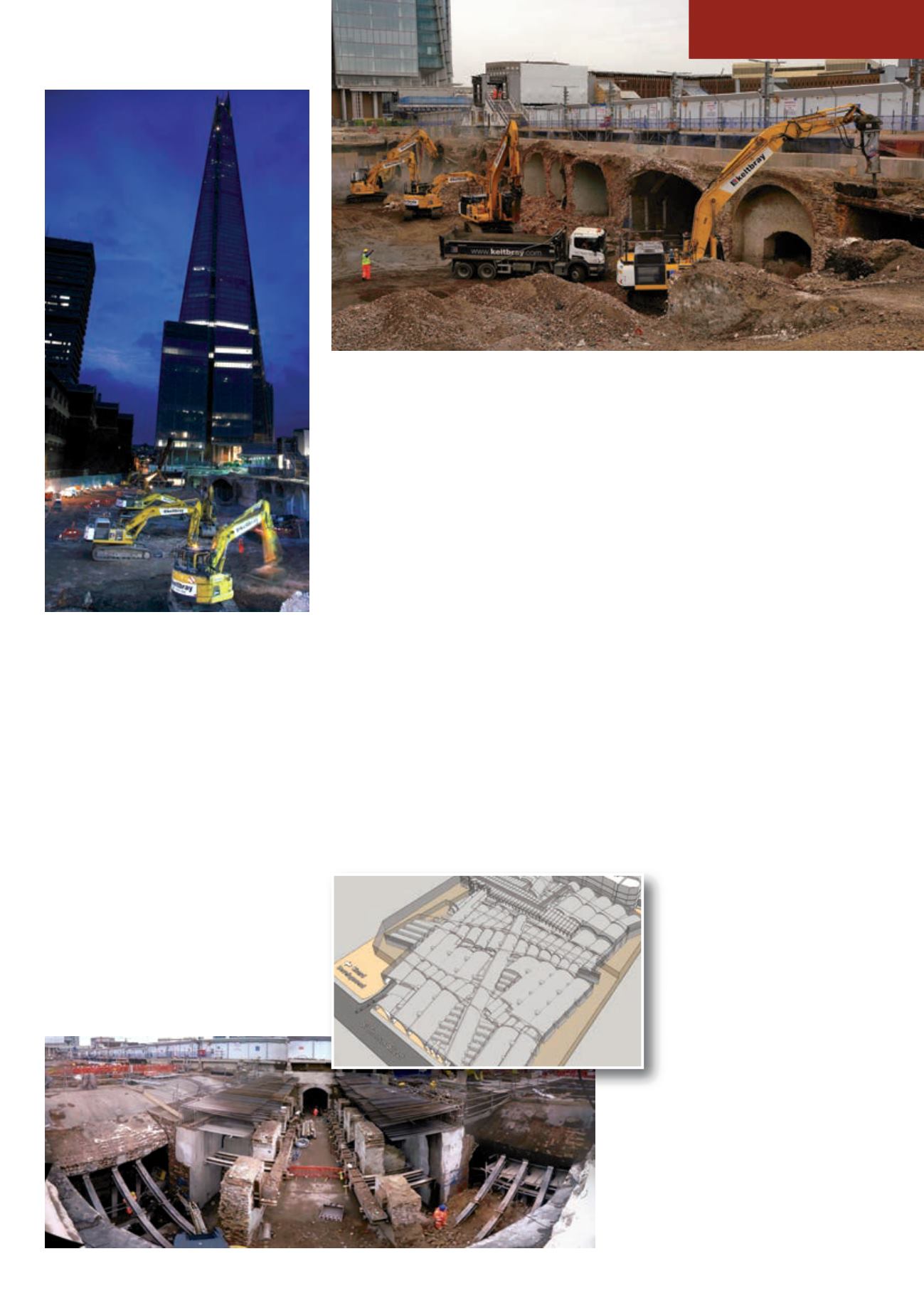
The 2014CivilsDemolitionAwardwent to Keltbray for its
work on phase 1 - 1A at LondonBridge railway station, which
sees 55million passengers annually
A rail
challenge
SITE REPORT
LondonBridge railway station
is close to the Shard and sees
150,000 passengers pass
through every day
An array of arches from various
dates had to be demolished
RIGHT: This schematic, with the rail lines and
platforms omitted, shows the variously sized
arches under the station.
BELOW: Retaining structures had to be put in
place during demolitionwork to ensure stability


