26
JANUARY-FEBRUARY 2015
d
&
ri
INDUSTRIAL
DEMOLITION
instead to enlarge a facadeopening and slide
thedryers out through thewall.
To reduce the turnaround timeDDM
suggested leaving the asbestos-containing
flanges untouchedbykeeping the entiredryer
intact and then remove the asbestos at another
location.Using this approach reduced the
turnaround time from five to threeweeks.
DDM’s facility inDeMeernhas a large,
fully equipped containment for themost
demanding asbestosworks so thedryerswere
transported there.All personnel on site are
suitable certified for the tasks theyhave to
carryout during such remediationwork.
Removing thedryers intact created a
problem, however. Eachdryer consistedof two
individual elements; an internal drum and an
external shell.DDM’s engineeringdepartment
cameupwith a custom-made frame suitable
for their lifting, skidding and transport, and
alsokept the twoparts as a single structure.
This conceptwas alsodirectly copiedby
themanufacturer producing thenewdryer.
Lowering thedrumonto theouter shell could
not be carriedout due to the resulting stresses
on the shellmaterial.
Once theweight transfer from theoriginal
dryer support structure to the temporary
frameworkwas achieved, the large concrete
supportswere then removed alongwith the
driveline. Todo this efficiently the concrete
wasweakenedby explosive cartridges as a
result of deflagration. This is a safemethod
that doesnot generate a shockwave and
minimises vibration, noise anddust. It
proved tobe very suitable in the tight space
surroundedby live equipment.
The tight spaces inside thedryer room
and the adjacent buildings in closeproximity
wereDDM’s next areaof concern. Thedryer
couldonlybe lowered inpositionbecause it
was built against the ceilingof the first floor
withonly5mm (0.2 inch) of space above
it - installing skid railswas the answer. The
floorwas levelled and thepavement outside
brought up to the same level. The railswere
installed, thedryer loweredonto the rails and
slidout.Other than theopening in the facade
and small items outside, no adjustments to
the structureof thebuildingswerenecessary.
All equipment andother itemswere able to
operateunhinderedduring the removal and
no interruptions toproduction resulted from
the removal operations.
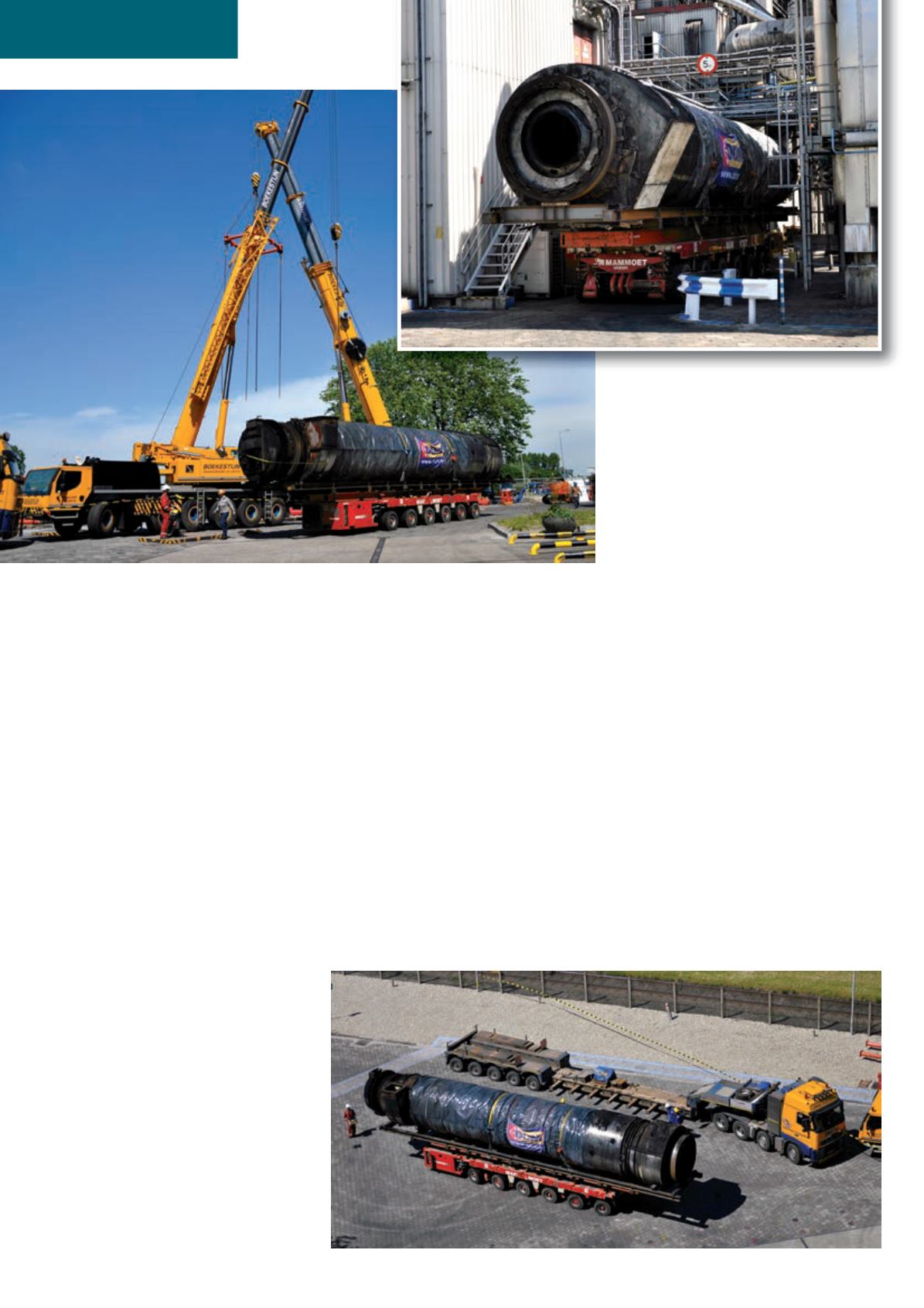
Onceoutside thedryer had tobe liftedon
a low loader for transport, but longbefore the
project commencedDDMhad carriedout a
dummy run andnoticed therewas insufficient
space for a low loaderwithin the lifting radius
of the cranebeinguseddespite the fact that
itwas oneof thebiggest in theNetherlands.
The solutionwas tomobilise a self-propelled
modular transporter (SPMT) that couldmove
thedryer between the adjacent buildings to
an areawhere therewas room for the low
loader andwhere thedryer could thenbe
lifted.Onceoutside, thedryerwas jackedup
and the SPMTdroveunder it. Thedryerwas
then loweredonto theunit and removed. This
was not only the safest but also themost cost
effectivemethod. In themeantime the sitewas
beingprepared to allow the installationof the
replacement dryers. The skid railswereplaced
back and all prefabricated support structures
necessary to install thenewdryer erected.
The carbonblackproductionprocess
produces a large amount of very fineblack
dust. Toprotect the surroundings and
prevent pollution thedryerwas hoseddown
andwrapped in foil.Once inDeMeern,
the complete trailerwas placedonDDM’s
industrialwash area and thedryer hosed
down again afterwhich it againwas inspected
for thepresenceof asbestos.
Todisposeof thedryer, the asbestos
containingpartswere cut out following
the asbestos survey that hadbeendrawn
upby an independent asbestos survey
company.All asbestos containingmaterial
was double-wrapped in foil andplaced in a
closedoff container ready for disposal.All
othermaterialwas reduced in size and then
transported to certified recycling companies
with all disposal done in accordancewith
Dutch legislation and regulations.
A total of 4.560kg (10,032 lb) of asbestos-
containingmaterial, 20,980kg (46,156 lb) of
concrete and24,620kg (54,164 lb) ofmetal
scrap resulted from thework, ofwhich91%
was released for recycling.
■


