13
d
&
ri
JANUARY-FEBRUARY 2015
DEMOLITION
EXCAVATORS
componentswith their associated costs. In
addition, because of thismaintenance in the
field is easier.
ThenewLDC eliminates thepossibility
of human error that could affect the stability
of themachine. A tactile colour display
shows diagrammatically thepositionof the
attachment in real time and informs thedriver
of the authorisedmovements that he can
make. Adisplayof theposition (levelness) of
themachine is alsogiven to thedriver.
The increase inworking envelope allowed
by thenew extended reachmeans that
demolitionworks canbe carriedout using
machines of smaller size than at themoment,
whichhas the addedbenefit of reduced fuel
consumptionduringwork aswell as easier
machine transport.
A PERSONAL VIEW
It is unarguable that Ipswich,UK, based
KocurekExcavators havebeenone of the
leadingproponents of high reachdemolition
excavators, withmore than100 suchmachines
havingbeenproducedby the companyover
the years.Duringmost of this time, thepublic
faceof the companyhas beenRonCallan,
whountil recentlyhad the jobof selling
the company’s services.He is nowwinding
downhis time as heheads for awell-earned
retirement. LindsayGale caught upwithhim
recently and talked about thedevelopments
hehas seenover the yearswheredemolition
excavators are concerned.
Over recent times, themaximumworking
Working at home
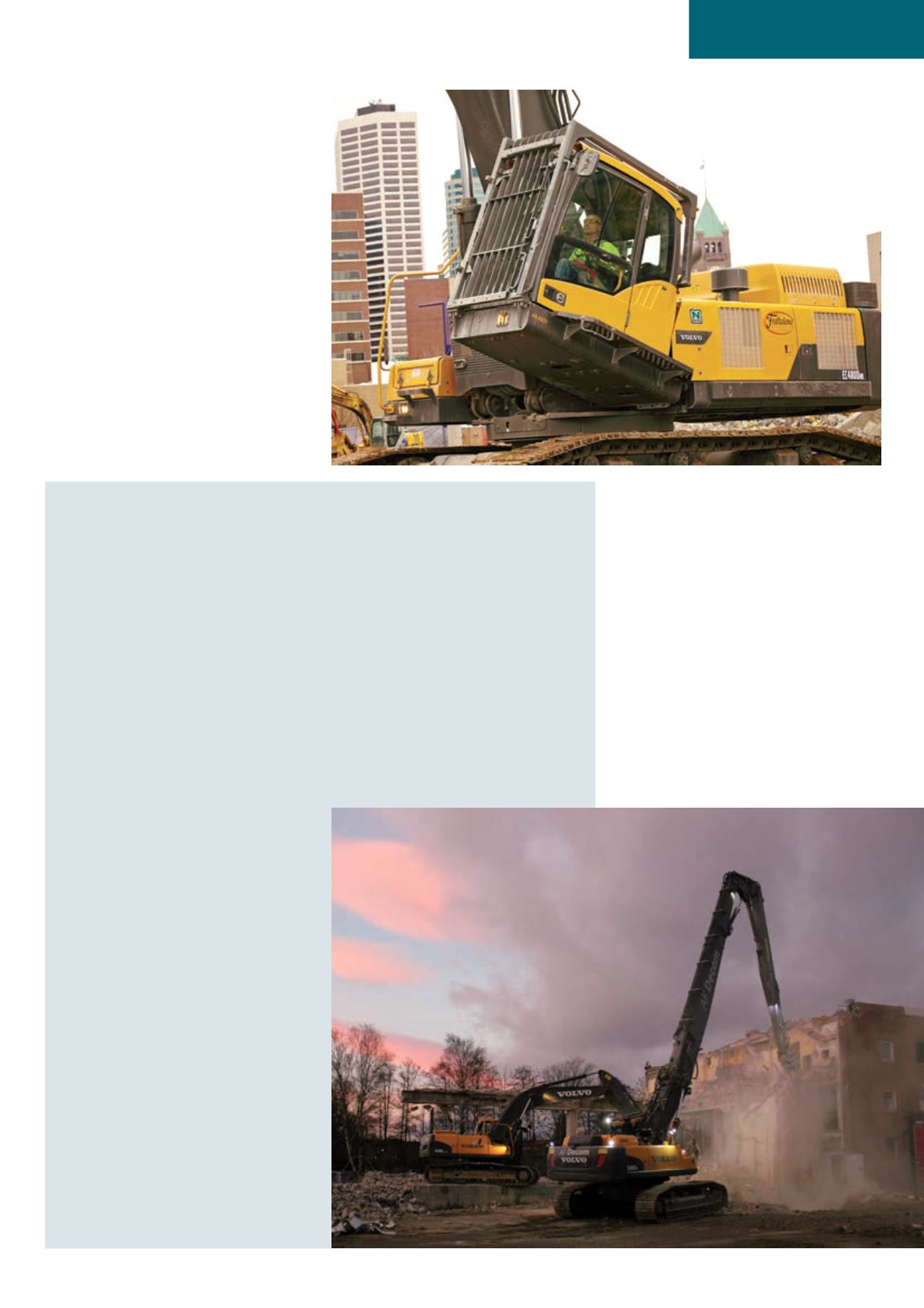
A27m (88.6 ft) Volvo EC460C-Series high reach excavator was rolled into Eskilstuna
in Sweden, site of Volvo CE’s old hardening plant, and slowly drove up to the back of the
building to start demolition.
“With thesemachines it is not just about getting the height,” said David Arnoldsson,
manager of Volvo CE’s special applications solutions team. “It is also about maintaining
machine control and stability at maximumworking height. As little as 10mm of boom
movement at the base of themachine can be over 1m (3.3 ft) of movement at the end
of the arm – so if misused thesemachines have the potential to become unstable. As a
matter of safety, features are fitted to prevent this, such as additional counterweights
and Volvo’s ‘slew angle limitation device’ fitted onto the slew ring that prevents the
superstructure straying outside its safe operating envelope. It is also good practice to try
to keep the superstructure in line with the track frame asmuch as possible tomaximise
stability.”
An additional safety feature is Volvo’s Total Moment Indicator (TMI). Using pressure,
angle and slew sensors this system provides a warning to the operator via an audible alarm
and lamp signal inside the cab if themachine is overloaded.
Unlike othermanufacturers, Volvo CE
fits an additional counterweight beneath
the existing counterweight of the excavator
(5 tonnes extra on the Volvo EC460B ultra
high reachmodel), as it is easy to fit and
remove, does not impede rearward visibility
or increase the slew radius at the rear
of themachine, which canmake it more
vulnerable to damage when slewing in
confined areas.
In the cab, the user has a choice of
foot pedals or joystick/buttons to operate
rotational or hammer equipment. Unlike
in excavation duties, high engine speed is
often not always a priority in demolition
applications. As a result, engine speeds
can be lower - just sufficient tomaintain
hydraulic flow to the attachment. Operators
are also assisted in seeing what is going
on at height by a camera fitted on the far
end of the boom that gives a view of the
attachment and also a spray system that
dampens the work area, acting as a dust
suppressor. Another option is a tilting seat
and console arrangement that helps to
prevent operators incurring neck or back
problems.
A heavy duty Volvo EC480D-Serieswas purchased
by US contractor Frattalone Companies to
demolish the oldMetrodome stadium in
Minneapolis. The boom connect system on the
machine allows themachine to be switched from
standard dig to high reach configuration


