44
lowering and travelling with a load,” a
company spokesperson adds. “The gantry
cranes also have self-propelled wheels or
roller tread options, which again allows for
a relatively easy move.”
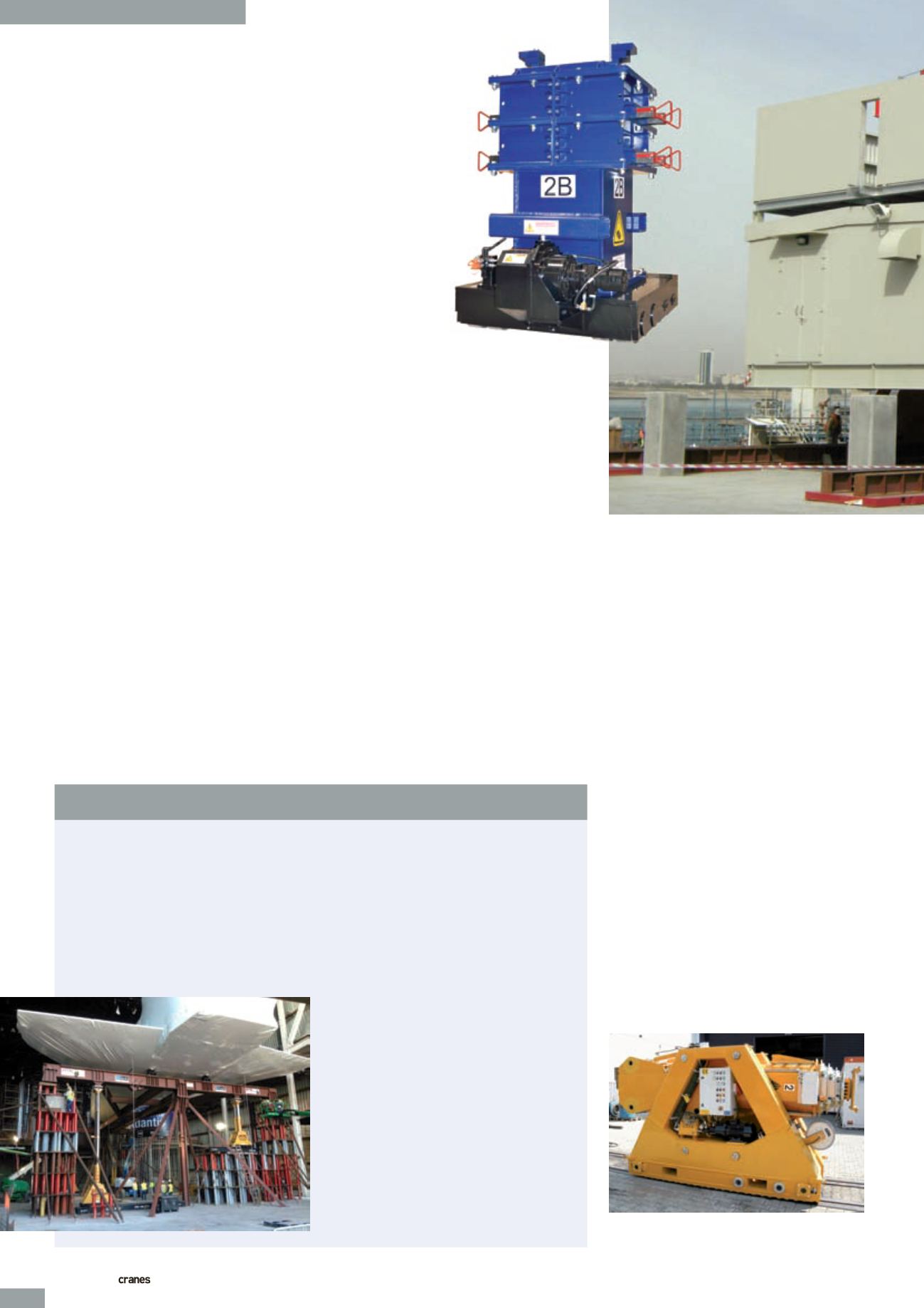
The Hoist and Haul Modular Jacking
System from Lift Systems is also compact
for ease of shipment. Modular components
include a 250 ton (226 tonne) ram, a 250
ton (226 tonne) powered dolly pod and
a 250 ton (226 tonne) climbing jack. The
Hoist and Haul Modular Jacking System
was launched at Bauma 2013.
Safety features
Overloading is an issue that manufacturers
across the lifting industry aim to
prevent from happening. To avoid such
a potentially dangerous situation, Lift
Systems offers a header plate-mounted
load weighing system. “This is a portable
system for use with a hydraulic gantry or
independently in other applications using
technology common with our CARL
Control System for hydraulic gantries,”
explains Forster. “This product can be
modified to suit customer needs with
HYDRAULIC GANTRIES
Affordability and ease of transport are two
of several factors influencing the use of
hydraulic gantries. LAURA HATTON reports
H
ydraulic telescopic gantries are
widely used in power generation,
construction, mining and oil and
gas industry applications. These are areas
where conventional cranes are also often a
preferred choice for end users.
A characteristic feature of hydraulic
gantries is that for their size they have
greater lifting capacity than mobile cranes.
The Hoist and Haul Modular Jacking
System from hydraulic gantry manufacturer
Lift Systems, for example, has a standard
capacity of 250 US tons (226 tonnes) per
leg. “The system has a 250 ton (226 tonne)
per pod standard capacity and operates on
standard hydraulic gantry track,” explains
Ben Forster, Rigging Gear Sales, Inc. “It
Shifting
traditions
also has 3 % gradability with full load and a
modular design for use on a wide range
of applications.”
Transport is another factor influencing
the range of applications that hydraulic
gantries are becoming involved in.
According to manufacturer Enerpac, on
average, a telescopic gantry has a 20%
smaller footprint than a crane, which, in
theory, reduces transportation costs and
transport complexities; it also takes up less
space in a factory. The Enerpac SBL1100
can be transported easily to a job site due
to its foldable boom and mast design, the
company says. “The gantry system also
has a wireless control system, which allows
automatic synchronisation for lifting,
INTERNATIONAL AND SPECIALIZED TRANSPORT
■
JULY 2013
SHUTTLE ROTATION
Lift Systems has helped move the space shuttle Atlantis to the Kennedy Space Center. The
shuttle is valued at more than US$2 billion and weighs 80 tons (72.5 tonnes) and is 37 m
long, 17 m tall and has a 23.5 m wingspan. It has served as one of the launch vehicles to the
International Space Station for thirty years.
Heavy haul and lift company Beyel Bros of Cocoa, Florida, USA was awarded the project.
For the job they had to perform the final transportation to the museum and the final placement
of the shuttle for exhibit. Engineering design and planning company BRPH, Ivey Construction
Delaware North and NASA were involved in all project details. For the final lift plan they agreed
for a custom designed and fabricated cradle fixture to be attached to the underside of the shuttle
for the lift and rotation operations.
To perform the lift and rotation of the
shuttle, an 800 ton (725 tonne) capacity model
48A hydraulic gantry system from a Lift
Systems was used. The system, developed
for Beyel Bros for the project, had a total
maximum weighing capacity of 1,000 tons
on four load weighing pods. The weight of
each lifting point was monitored by NASA
throughout the lifting and rotation process.
After testing the system, the shuttle was lifted
and rotated to an exact 42.21 degree angle.
The Atlantis exhibit at the Kennedy Space
Center opened on June 29th, 2013.
The SBL1100 foldable boom and mast section is
ideal for low-height clearances
The Hoist and
Haul system from
Lift Systems, left.
Capacity is 250
tons per base


