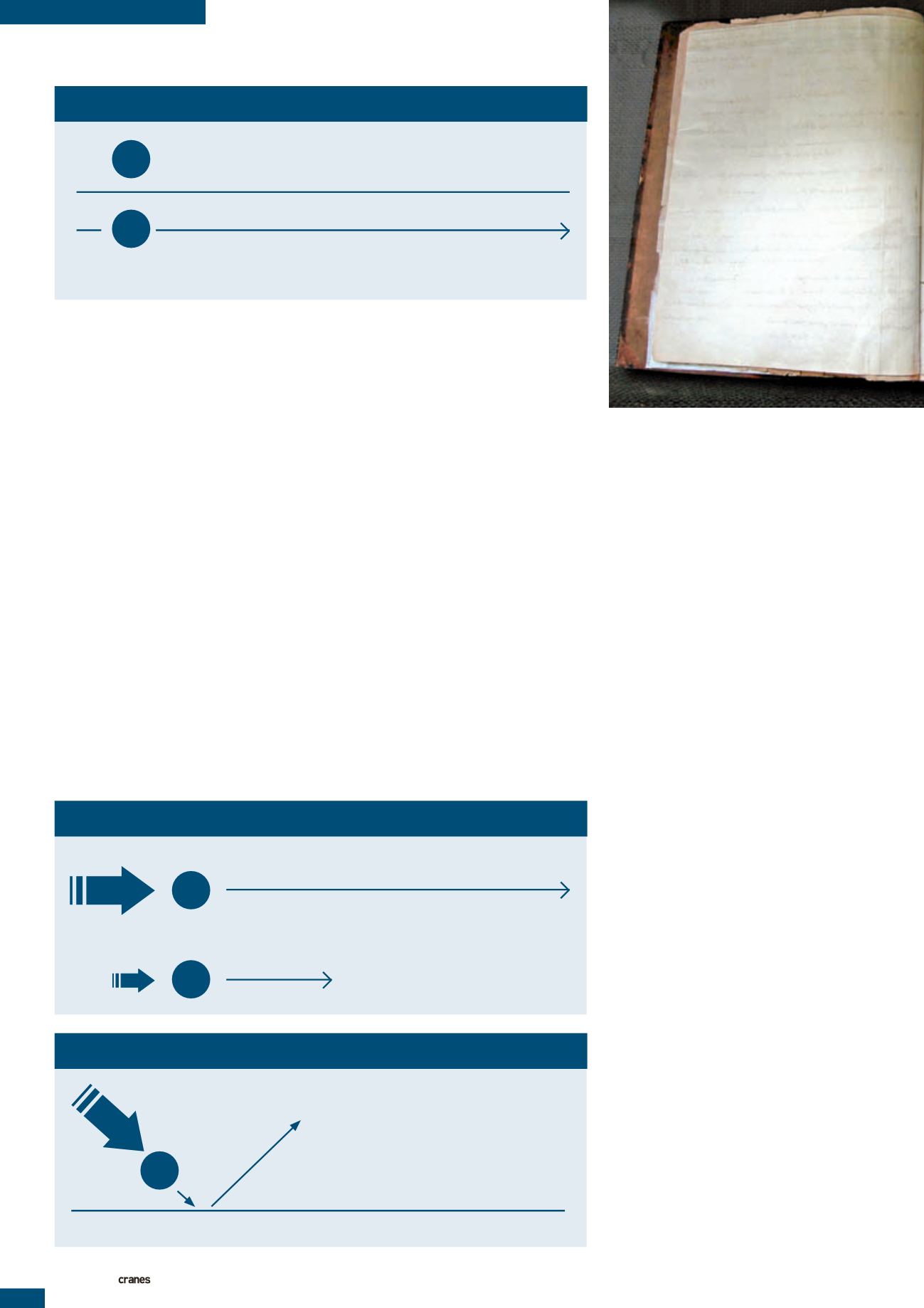
NEWTON’S THIRD LAW
NEWTON’S SECOND LAW
34
THE KNOWLEDGE
INTERNATIONAL AND SPECIALIZED TRANSPORT
■
JULY 2013
constant speed in a straight direction.
This first law basically states that an
object is in rest (zero velocity) if there is no
external force applied to it, this is the easy
part. This law also states that if no resulting
force is applied to an object it could as well
be moving at a constant speed in a straight
direction, this is a bit harder to fathom.
Imagine a hockey puck that is struck and
slides down an asphalt surface. Due to the
friction, a resulting force, between the puck
and the asphalt, the puck eventually stops
sliding. Now let’s assume that this same
puck is struck and it slides down an ice
track. The distance the puck travels is a lot
further than on asphalt because the friction,
a resulting force, between the puck and ice
is much less. If the ice could be so smooth
that the friction would be zero, then this
puck would keep travelling in a straight line
with a constant velocity and never stop.
How is this applicable in our industry?
A frequently used method of moving loads
is skidding. In its simplest form, skidding
is the overcoming of friction by applying
a resulting force, often in the shape of
an hydraulic pushing ram, on a friction-
reducing material such as Teflon (PTFE)
on stainless steel. The lower the friction
between these two materials, the lower the
effort can be to move the object. Once the
hydraulic ram stops pushing (at the end of
the stroke), once again the friction force
is the resulting force and will return the
object to a state of “at rest”. If there would
be no friction between the Teflon and
the stainless steel, the object would keep
moving at a constant speed at the end of the
stroke. Obviously an unwanted situation.
Even though we want the friction to be
as low as possible, we still rely on it being
present at the end of the stroke.
NEWTON’S SECOND LAW
If there is a resulting force on an object
it will accelerate. The acceleration is in
the direction of the resulting force and is
directly proportional to it, and it is inversely
proportional to the mass of the object.
This law is an extension of the first law.
It basically states that if the resulting force
on an object doubles, then the acceleration
also doubles, this is directly proportional.
If the mass of an object doubles while
applying the same resulting force, then
the acceleration halves, this is inversely
proportional. The relation between the
resulting force, the acceleration and the
object’s mass can be expressed in a formula:
F = m × g where F is the force expressed in
Newtons, m is the mass expressed in kg and
g is the acceleration expressed in m/s
2
.
How is this applicable in our industry?
We know from Newton’s first law that
without a resulting force the object would
keep sliding on the Teflon and stainless
steel skid track.
Newton’s second law states, however,
that when a resulting force is applied,
the friction force, an acceleration, takes
place. Since the object slows down, the
acceleration has a negative value and is also
called a deceleration.
Another application of Newton’s
second law is when a driver decides to
apply his brakes, which is considered
another resulting force, he would come to a
standstill. If he pushed the brakes twice as
hard, the acceleration will double, due to
F = m × g and he will stop twice as fast.
NEWTON’S THIRD LAW
When an object exerts a force, F1, on
a second object, the second object
simultaneously exerts a force F2 = −F1
on the first body. The forces F1 and F2
are equal in magnitude and opposite in
direction. This law is also known as
“action = −reaction” and has often been a
law of controversy.
Imagine that you are pulling on a rope
that is attached to a wall, you pull with 110
pounds (50 kg). Actually you pull with a
force of approximately 500 Newton.
Now replace the wall by a person who
pulls on the other end of the rope. The
controversy has been in the belief that if
each person pulls with 250 N there will
Newton’s
Philosophiæ Naturalis
Principia Mathematica
With no outside forces, this object will never move
With no outside forces, this object will never stop
The more force ...
The more acceleration.
Every action has an equal
and opposite reaction
NEWTON’S FIRST LAW


