42
INDUSTRY FOCUS
TELEMATICS
ACT
FEBRUARY 2015
This costmayvaryupwardbasedon the
valueof your crane– something tangible
to look into for every craneowner.
Obviously, the simpleGPS trackingof a
machine allows theowner to seewhere
his equipment is at all times. In the caseof
moremobile truck and all-terrain cranes,
carrier speeds canbemeasured and alerts
set if drivers aregoing too fast between
jobsites.
Abigquestion for a craneowner is this:
Ismyoperatormakinggooddecisions?
Identifying riskydriving andoperation
behaviors earlyonmayhelpprevent future
incidents andpotentiallygiveyouhard
facts to reduceyour insurancepremiums.
MEASURINGPRODUCTIVITY
.How
productive is your operator? Ishe taking
his timegetting to the jobsite?Doeshe
boomup excessivelyoruse thewinch
more?Was the100-ton cranenecessary
for this jobor could I have sent outmy80
tonner?Telematics reporting can answer
all thesequestions.
These are a few commonlyused items to
defend theuseof telematics of equipment
and fleet vehicles and again,withyour
investment in cranes of all sizes, these
items canbemagnifiedbasedon the
hourly cost tooperate.
Somemay think that telematics
technology is a little likeBigBrother, but
in this scenarioyou are theBigBrother.
It is your company, your equipment and
your liability at stake.
Today, telematicsdata is beingprovided
to craneowners bymany fine crane
manufacturers.Most havebeen in this
game a lot longer thanLink-Belt. Sowhy
isLink-Belt different?Youownyour own
data.
Fromdayone, bothprivately andour
public announcement atCon-Expo last
year,wedetermined that the craneowner
owns thedata.
But how canweguarantee that
ownership, ifwe are collecting thedata?
Our answer is that Link-Belt’s role in this
is to install the communicationdevices,
transmitter and antenna to transmit
thedataon all of ourmodels.A1A’s
iCraneTrax collects thedata. The crane
ownersdeterminewho they share itwith,
as they see fit.
Withour telematics solutionyou can
decide from thevery firstmoment if you
want to shareyourdataornot.And, of
course, at anypoint you can also change it.
There are several options you can choose
from tobest control yourdata:
1
Share all datawithLink-Belt andyour
distributor. (We, themanufacturer,
don’t see thedataunless the crane
ownerwantsus to see thedata. The
distributordoesn’t see thedataunless
the craneownerwantsus to see the
data.)
2
Share all datawithLink-Belt only.
3
Share all datawithdistributor only.
4
Shareonlydiagnosticdatawith
distributor orLink-Belt.
5
Donot share anydata.
However, sharingdiagnosticdata is a
cool feature that our system incorporates.
Let’s sayyour crane is at a jobsite and
ishaving an issue. First you can logon
to iCraneTrax.com and tell your crane
operator togo into theLink-Belt Pulse
system and set the crane inDiagnostic
mode.What happens then?
Diagnosticdata from the crane (more
datapoints/information thannormal
operation) are sent or “burst” to the
iCraneTraxdashboard every10 seconds
for 10minutes.Data from theRCL,
on-highway engine, off-highway engine
andboom canbe sent at this time.
With this information, you can then
collaboratewithyour service tech and
see if you candetermine the issueby
analyzing thedata coming in. If you
still can’t figure it out, call yourdealer’s
service representative.He can login tohis
company’s iCraneTrax.com account, and if
you enabledata sharing, he can look at the
samedata as you fromhis account.
One step further, the craneowner, dealer
service tech andLink-Belt’s in-house
servicedepartment can all collaborateon
the issue todetermine a solution. You can
always set yourdataback to “not share” if
you choose.
Imagine the time andmoney savedby
not having to send a service techout first
to try to figure it out. Everyone canbeon
the samepage at the same time from any
location.What if the repair requires apart
andyouhave to sendyour service tech
back to the shop toget it?The faster you
canget your repairdone, the faster the
crane canget back towork,makingyou
moremoney.
Theburst technology I described
above is the “mother lode”of data that
our system can send, but basedon the
typeof telematicsunit installedonyour
crane (assuming it’snot aLink-Belt)will
determinehowmuchdatayourmachine
can feed into a system.
Next, let’s lookbriefly at different reports
basedon the typeof telematicsunit
utilized.
BASICGPSSYSTEM
. These systemsusually
report locationonly, and there areunits
out there that you can install onnon-
powered equipment like trailers and even
boom sections, soyou can track their
location andbe alerted in caseof theft.
BASIC TELEMATICSSYSTEM
. These systems
report location and report somebasic
operation information like enginehours,
ignitionon/off, andodometer.
INTERMEDIATE TELEMATICSSYSTEM
.
These systems report location and
more advancedoperational data. These
systems can report diagnosticdata from
theECMof your equipment, track
speed and location, detect hardbraking,
cornering, acceleration and capturepre
andpost impact data. They can also
report operational data like enginehours,
ignitionon/off, andodometer.
ADVANCED TELEMATICSSYSTEMS
. These
systems report location and advanced
operational data. These systems can
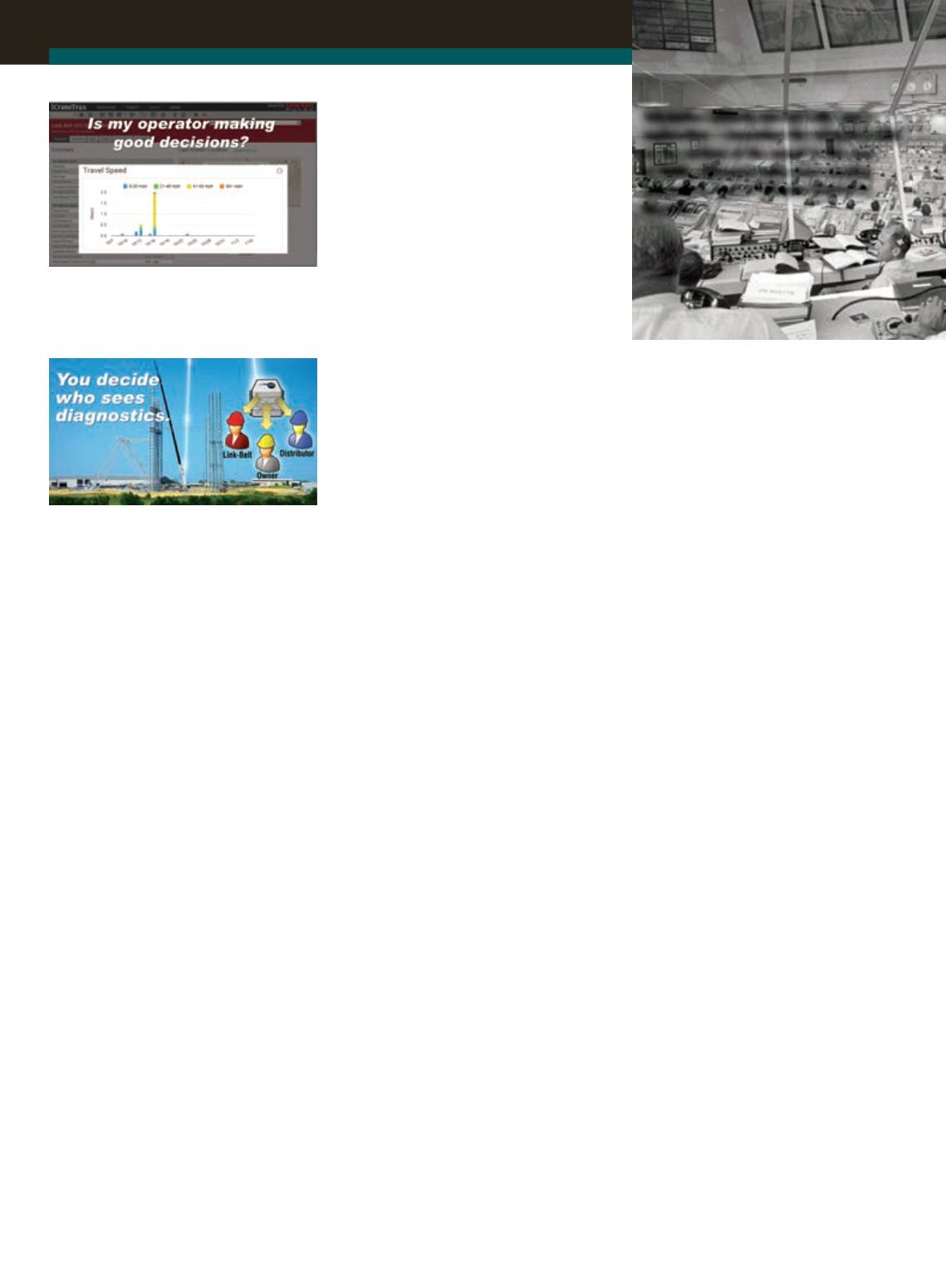
Identifying risky driving and operation
behaviorsmay help prevent future incidents
and potentially give owners hard facts to
reduce their insurance premiums.
The difference in the Link-Belt telematics
system and other crane OEM systems is that
the crane owner decideswho gets to see
the data.
Telematics actually startedwith space
exploration – remember the telemetry units
on the surface of themoon? In the case
of NASA, telemetry unitswere sending
information back toMission Control in
Houston.


