IRN JANUARY 2014
year – and increased engagement in international
markets.
Ms Boyd, speaking to
IRN
by telephone from the
US, says the much talked about increase in rental
penetration in the US has helped propel the North
America growth, with some contractors now
favouring rental over ownership; “It appears that it
will continue to trend that way – a lot of people got
stung when the downturn came.”
At the same time as that ‘secular shift’, other
markets have opened up; “There is an ongoing
upturn in oil and gas production in North America.
So that has continued to absorb more equipment.”
While Ms Boyd remains cautious about the US
economy – describing it as “solid, but not robust” –
it is HERC’s North American business that has been
driving the improved results, which is not surprising
given that it still represents more than 90% of the
company’s annual US$1.4 billion revenues.
With the growth have come significant changes
in the way HERC operates in North America, with
traditional construction markets now representing
35% of revenues, down from 50% at the peak of the
market in 2006 when HERC’s revenues were nearer
$1.7 billion.
Industrial growth
Filling the gap has been the ‘industrial’ sector, which
now accounts for 25% of the total, up from 15% in
2006. “Construction business has been HERC’s claim
to fame, but it’s very cyclical”, says Ms Boyd, “We
need diversification and stability in the business,
and we need to be the right size to take construction
business when it comes back. Industrial sectors
are more stable – they are always doing plant
turnarounds and shutdowns [for maintenance].”
This has meant that HERC has had to restructure
its depot footprint, migrating to new areas where
its customers are, whether through acquisitions or
greenfield openings.
Hand-in-hand with this diversification has been a
new hub and spoke strategy, with plans to develop
around 20 to 25 major hubs, centralising fleet
servicing and repair activities.
“We expect to have eight to 10 superhubs by
13
HERTZ INTERVIEW
Balancing act
Lois Boyd, president of Hertz
Equipment Rental Co (HERC),
tells
IRN
about juggling
priorities at a business that
is growing fast in North
America and facing enormous
opportunities in
markets like
China and the
Middle East.
L
ois Boyd had little control over when she
was appointed president of Hertz Equipment
Rental Co (HERC) in April 2011, but it has
proven to be good timing, with her tenure coinciding
with the US rental recovery and the return to growth
of the HERC business itself.
She was probably due a break, since her previous
task at Hertz had been to take Advantage Rent A
Car – acquired by Hertz out of bancruptcy in 2009 –
back into profitability, something that she achieved
before the switch to HERC.
Since then her leadership at the
rental business has been a story
of capitalising on the North
America upturn – HERC’s
revenues grew by 12%
in 2011, 15% in 2012
and 14% in the first
nine months of last
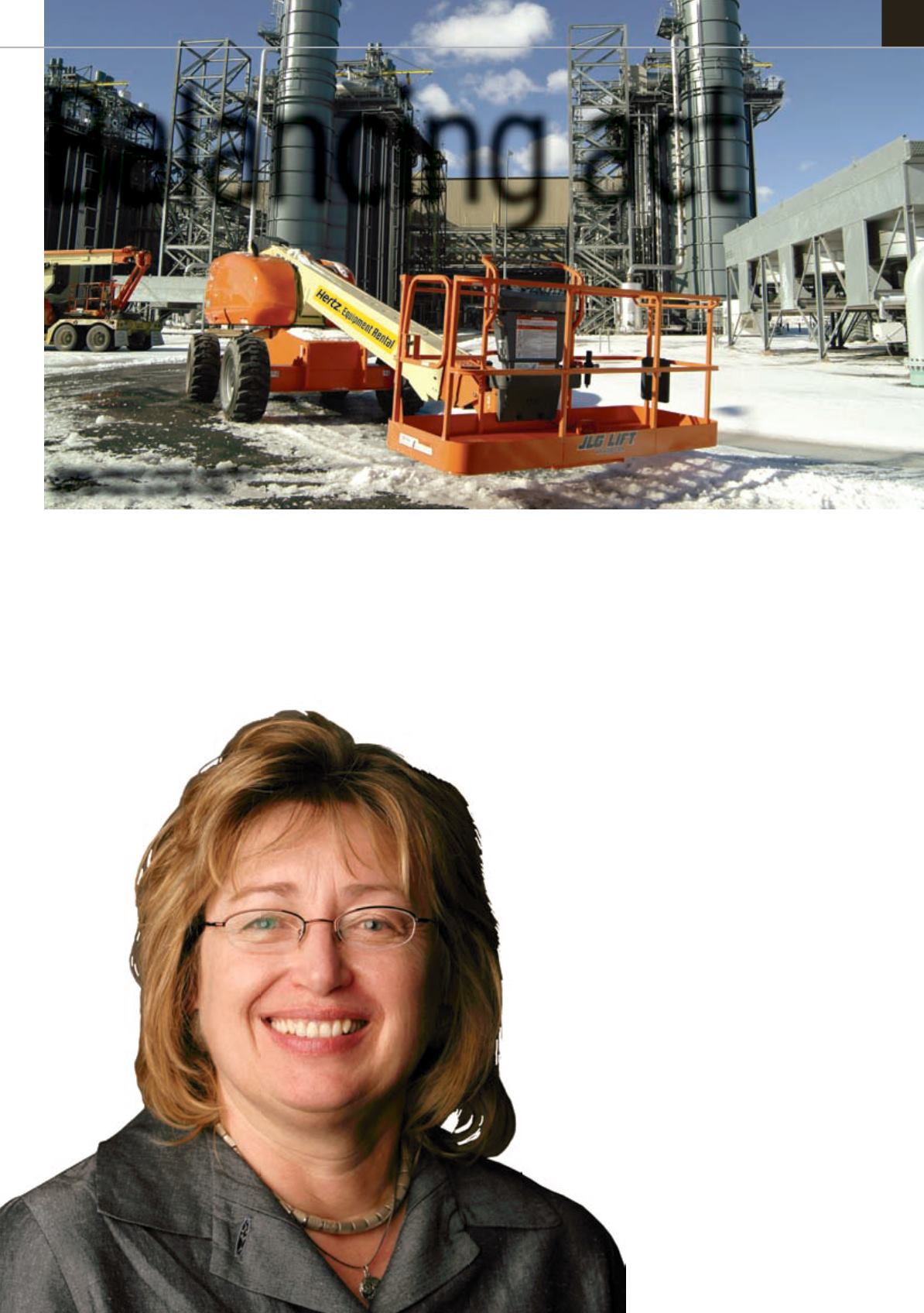
Lois Boyd,
president
of Hertz
Equipment
Rental Corp
(HERC).
‘Industrial’ rentals now account for around 25% of
HERC’s total business, up from 15% in 2006.


