INTERNATIONAL AND SPECIALIZED TRANSPORT
■
JULY 2013
ALL TERRAIN CRANES
15
T
raditionally it has been typical for
all terrain cranes above a certain
capacity to have two engines; a
large one in the carrier for road travel and
another smaller one in the slewing upper
structure to power the crane. A growing
trend however is to use one engine to
power everything instead of two.
There are pros and cons to each concept,
either of having a one or two engine
design. Arndt Jahns, product manager, all
terrain cranes at Terex, says, “To have only
one engine means you optimise space,
maintenance and you save costs. Having
one engine also overcomes issues from the
effect of the Tier 4 Final regulations, where
there is less physical space to accommodate
the components.”
Further arguments for the one engine
“Secondly, a smaller engine normally uses
less fuel compared to a bigger engine. As
a rough calculation, a two engine design
can save up to 3 litres of fuel per hour.
Multiply this by 1,500 hours and end users
can save 4,500 litres per year. With a litre of
fuel priced at Euro €1.50, potential savings
could be Euro €6,200 a year. Over ten years
there is a potential saving of around Euro
€60,000.”
New models
The one engine design concept has been
adopted by crane manufacture Liebherr
on its new 300 tonne capacity
LTM 1300-6.2. The new crane, a
replacement for the LTM 1250, was
introduced at Bauma 2013. Instead of
the twin engine concept normally used
on cranes in this class, the LTM 1300-
6.2 is powered by a single engine with
a mechanical shaft drive for the upper.
Wolfgang Beringer, spokesman at Liebherr-
Werk Ehingen, explains the design, “Drive
shafts are routed from the distributor gear
in the substructure via two bevel gears
up through the centre of the slewing ring
to the hydraulic pump distributor gear in
the superstructure. The mechanical shaft
ensures a particularly high efficiency.
Low engine speeds in the chassis engine
design are presented by crane manufacturer
Liebherr, which says that when it comes to
replacing an engine, it is easier and cheaper
to replace one instead of two. In addition,
weight saved from removing the second
engine can be used to get extra capacity,
boom length or counterweight, Liebherr
says.
The weight saving potential, however,
may be less than it first appears. Thomas
Schramm, general manager at Tadano
Faun, says, “When you have a single engine
you have to transport energy either through
mechanical or hydraulic connections to the
point of use. These additional components,
including extra oil coolers, piping or prop
shafts and gearboxes, add weight, but they
are necessary to transfer the power from the
carrier to the upper structure. In addition,
these parts will need to be maintained or
replaced after some time. So the weight
saving to a large extent is cancelled out by
these additional components you have
to install.”
Additional positives cited for a two
engine design approach include lower
running costs and less maintenance. “A
large, single engine that is operating all the
time will require maintenance at a shorter
interval compared to two engines, which
only run for half the time,” said Schramm.
Using one engine instead
of two is a growing trend in
all terrain cranes. LAURA
HATTON finds out more
about this and other
AT developments
Design choice
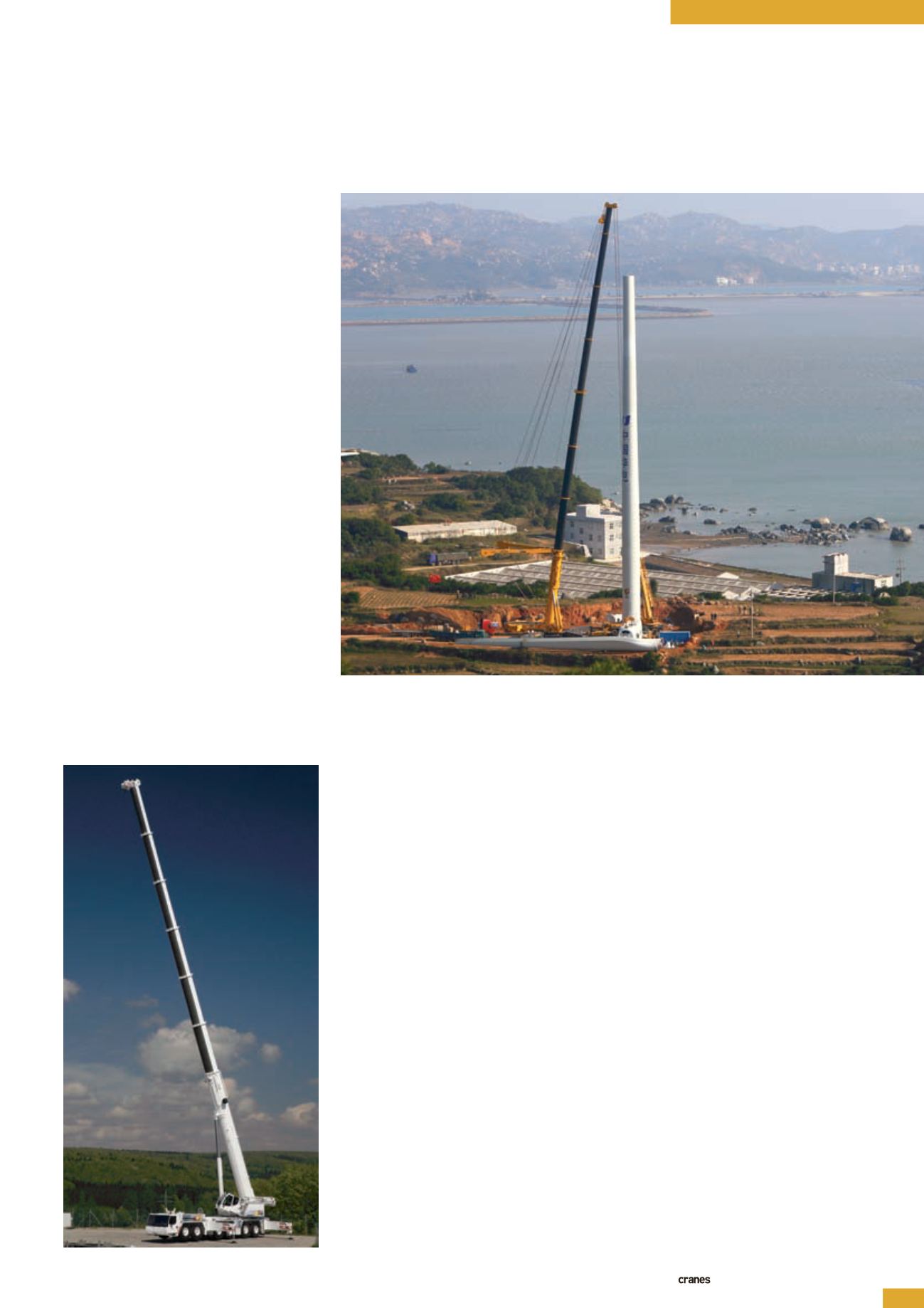
XCMG 1,200 tonne capacity QAY1200
all terrain crane working on the Carp
Hill wind power worksite in Fuqing
City in the West Coast Strait Economic
Zone of Fujian Province, China
The new LTM 1300-6.2 is
claimed by manufacturer
Liebherr as the most
powerful 300 tonne
wheeled mobile crane in
the market
>


