EQUIPMENT
64
international
construction
january-february 2014
Volvo Penta
Construction push
Engine manufacturer Volvo Penta wants to get
more and more of its diesels into construction
machines. President
Björn Ingemanson
tells
Chris Sleight
why and how.
where the company is not present
– crushers, cranes, compressors,
gensets and so on. It is a tough fact
of life for Mr Ingemanson.
“If Penta had been a totally
independent company, the market
would have been much bigger and
that would have been interesting.
But we are a part of the Volvo
Group, with all the benefits that
gives us. That is just the way it is.
“I agree that competitors to Volvo
Construction Equipment should
not have Volvo engines, but it does
mean there is a big part of the
industry that we do not have access
to. There are also borderline cases,
where we have to have a discussion,
and sometimes we can go into a
different division of a company.
For example, Sany in China is a big
competitor to Volvo Construction
Equipment, but we work with
them in other areas,” he said.
Developed markets
The initial focus for Volvo Penta
is in the more heavily legislated
developed markets of Europe and
North America, but that too will
change over time according to Mr
Ingemanson
“So far, our engines have mainly
been developed for the Western
World – Europe and the US and
those types of markets. We have
not had the sort of engines that will
compete with locally produced or
joint-venture engines in China and
so on.
“But now with the Volvo Group’s
activities growing a lot in Asia and
South America, we see that we can
benefit a lot form that, with local
production and a service network
in place.
“As a small player, we could not
start our own engine factor in
China with the kind of volumes we
have. But if the group could supply
engines form a factory to be fitted
in trucks, busses and construction
equipment, and then it makes sense
to add more volume on for Penta.
That will help us grow in these
markets,” he said.
But unlike other parts of the
Volvo group where there are
different brands to address
different market segments – Volvo
Construction Equipment as a
premium brand and SDLG as a
mid-range producer, for example
– the focus for engines is to keep
everything under the Volvo Penta
umbrella.
Mr Ingemanson said, “We are
a premium engine producer, so
we only compete today in Asia in
the top part of the pyramid with
Western producers. What we will
now do is come down in cost so
we can compete in the top end of
the JV market as well. That will
definitely help us.
“We believe being an engine
supplier to different applications
and segments, you cannot really
have a multi-brand strategy
positioned at the high-end, mid-
range and so on.
“We are here to grow the Volvo
engine business. If we bought a
small engine manufacturer in Asia,
for example, their product would
not fit in with the rest of the Volvo
range. We are here to make engines
that fit into the Volvo Group range
and then see where we can go after
that.”
Focus on growth
And where does Mr Ingemanson
see this strategy taking the
company over the next few years?
“Growth is the key for Volvo
Penta. We have a strong operating
margin even though the sales
volumes are not as high as we
would like.
“We see there is a potential for
us to double our sales volumes
in industrial engines. We have a
plan surpass 10,000 engines in
the year 2015 – that’s not only
construction, that’s all industrial
areas like gensets,” he said.
iC
V
olvo Penta, the diesel engine
manufacturer which is a
sister company to Volvo
Construction Equipment, is best
known in the marine segment,
where it has a pre-eminent
position. However, the last few
years have seen it make a concerted
effort to diversify into other areas,
and construction equipment is one
of those.
On the one hand, it makes sense
to find new markets, but it is also
a challenge in a crowded industry
like construction equipment,
where there are already plenty
of engine suppliers. So with the
area well-covered, one of the first
questions to Volvo Penta CEO
Björn Ingemanson is what can the
company bring to the party?
“The solutions we have picked
for Tier 4 Final is an area where
we see a strong benefit compared
to many of our competitors,” he
said, referring to the company’s use
of a selective catalytic reduction
(SCR)-only design for its engines.
This is to say there is no other
aftertreatment like a diesel
particulate filter (DPF) to meet
the latest strict emissions laws in
Europe, North America and Japan.
He added, “Of course we need
to differentiate and work on other
solutions. We offer a start-stop
option on our engines and we are
working on other ‘soft’ areas that
make us different. But I think with
the Volvo Group’s strong brand in
this industry will help us to grow
into the construction business.”
A complicating factor is that
Volvo Penta has agreed not to
supply any engines in areas
that would compete with Volvo
Construction Equipment. That
closes off the vast majority of the
market, leaving only a few pockets
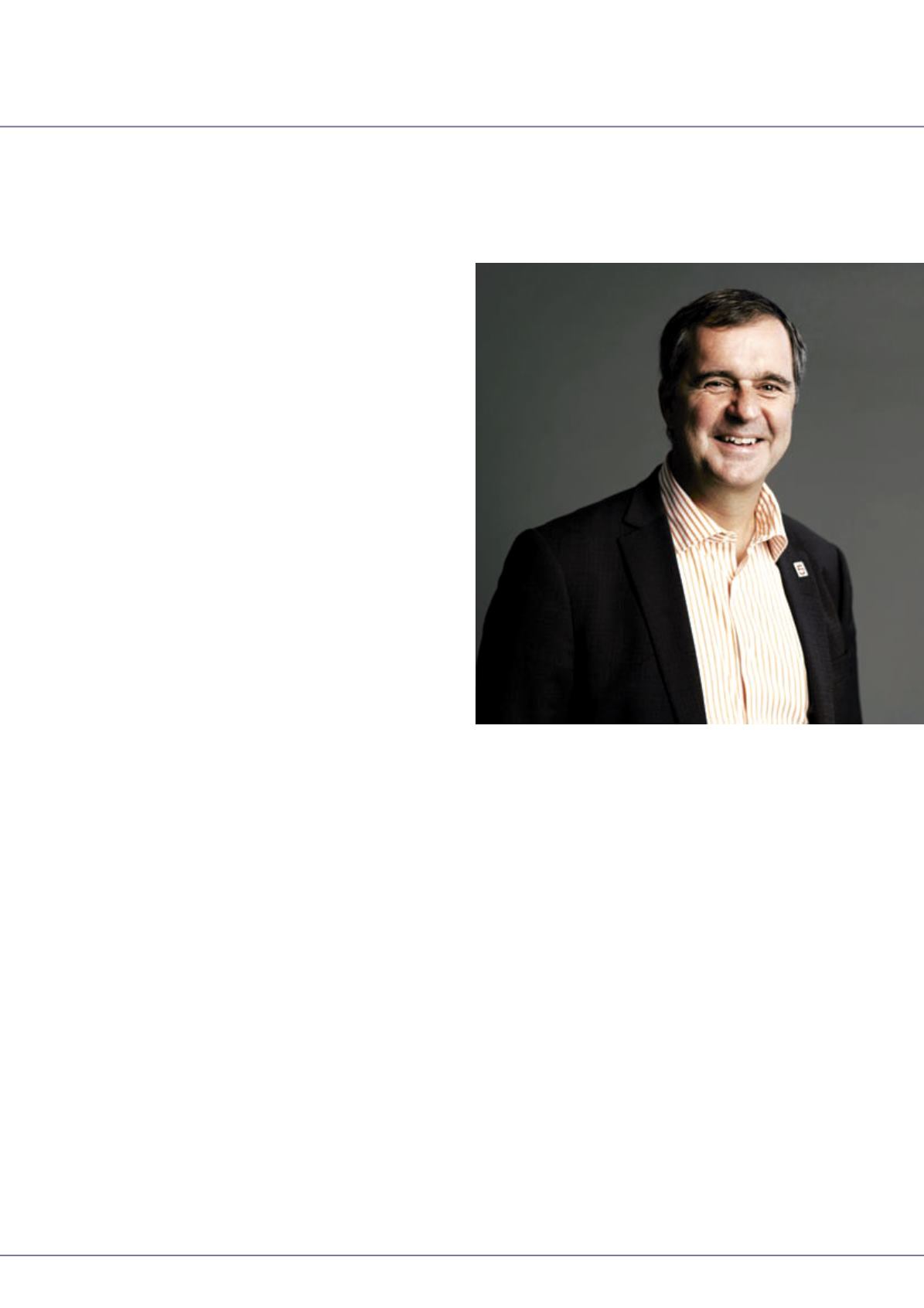
Volvo Penta president
Björn Ingemanson.


