55
EQUIPMENT
october 2013
international
construction
Volvo
The end of August saw Volvo give an insight into
its ongoing R&D and the rational that lies behind
it at an Innovation Day at its Eskilstuna, Sweden
facility, during which it announced the introduction
of its Tier 4 Final/Stage IV engine solution.
Lindsay Gale
reports.
reported previously by
iC
, it is also
carrying out R&D on the use of
hybrid drive systems. In both cases,
there are no immediate plans for
Volvo to introduce any equipment
that feature these driveline solutions
– it is more a situation of Volvo
being ready for possible future
customer-led demands.
More a concept than a real
production model, Volvo’s fifth
radical equipment design was
also shown for the first time. As
yet without a name, the Volvo
300 concept design for a mini-
excavator makes use of established
technologies as well as a number of
theoretical elements that are either
under development or are still to be
developed.
It also took its concept designs
further by unveiling what it calls
‘the Plan’, which was a video
showing various of its concept
designs (particularly its future ADT
and excavator concepts) operating
on an autonomous site ‘somewhere
in the world’ with no operators
behind the wheel and all machine
operations controlled from a central
location.
iC
A glimpse of the future
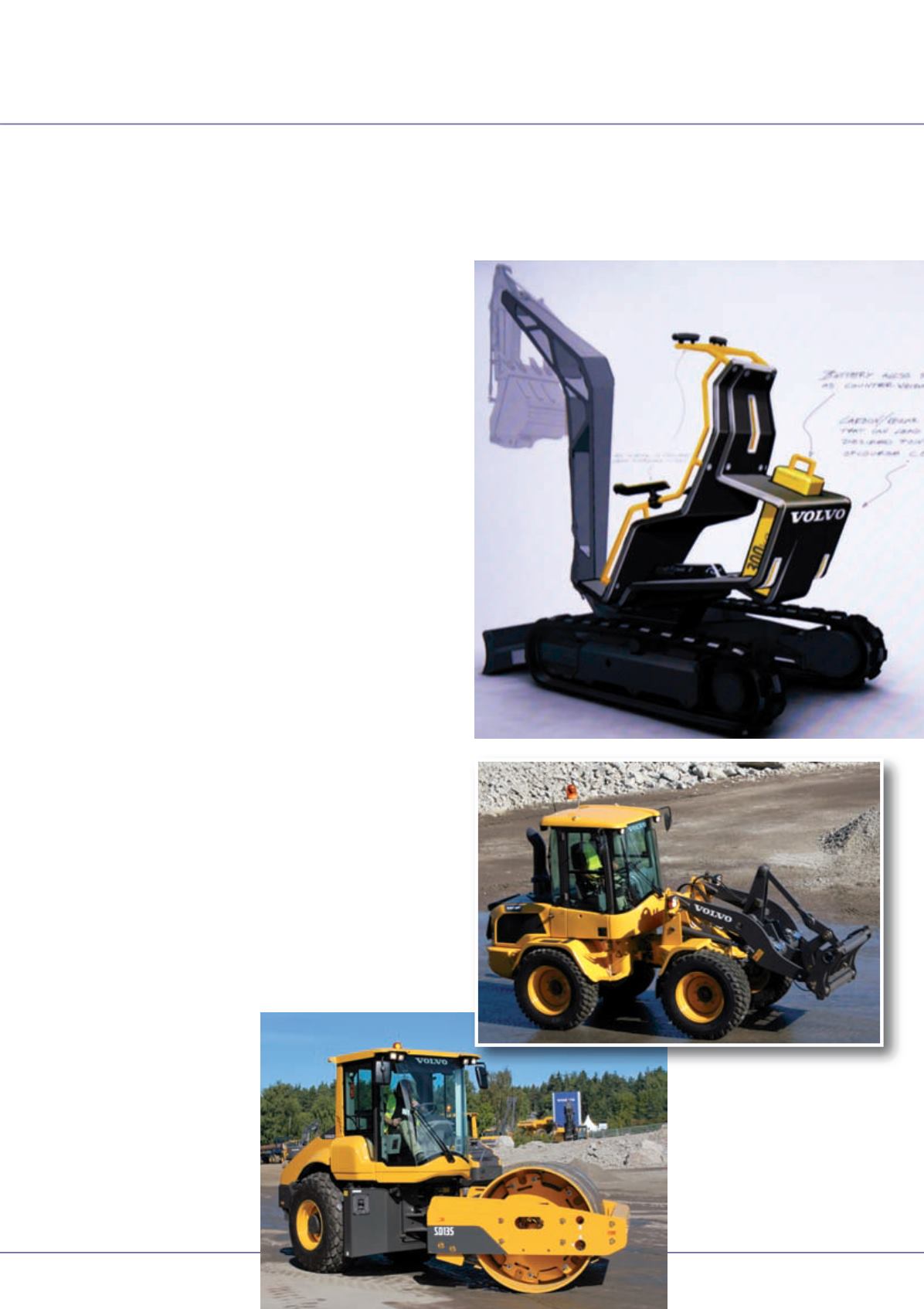
The Volvo 300 is the fifth
concept design developed by
the company, in this case a
radical mini excavator.
The SD135 is one of two new soil
compactors introduced at the
same event.
T
he meat of what Volvo
Construction Equipment
termed its ‘Innovation
Day’ was the announcement of
the six-engine range that will
start to be introduced in 2014
to meet Tier 4 Final/Stage IV
engine emission legislation in the
US and Europe. Exhaust after-
treatment is the key to meeting
these stringent regulations, with
the new engines featuring selective
catalytic reduction (SCR), a diesel
particulate filter (DPF) and external
exhaust gas recirculation (EGR)
driven by either a variable geometry
or waste gated turbocharger.
According to the company, the
new engines have undergone bench
and multi-application field testing
and have proved to reduce nitrogen
oxide emissions by -80% to just
0.4 g/kWh. They offer a +5%
increase in fuel efficiency and a -5%
reduction in CO
2
emissions over
their Stage IIIB equivalents.
The test programme involved
more than 25,000 running hours
in articulated haulers, wheel
loaders and excavators in a range
of environmental conditions, from
sub-zero temperatures to extreme
heat and at high altitude.
Volvo also outlined the
developments it has been
examining where drivelines are
concerned. Continuously Variable
Transmissions (CVTs) have been
used with success in the agricultural
equipment sector for a number
of years, and Volvo has been
examining this technology with a
view to help wheel loaders move
+50% more material using the
same amount of fuel as today. As
The L35D compact loading shovel
was introduced in Eskilstuna and
was joined by the smaller L30D.


